Can Dogs Eat Strawberries?
Strawberries are safe for dogs and mostly water, so the real question is sugar. How many is too many, which dogs should skip them, and the one preparation that is genuinely dangerous.

Yes, dogs can eat strawberries. They are not toxic, they are mostly water, and a dog that steals one off the counter is fine. The part worth paying attention to is sugar: strawberries carry about 5g of it per 100g, which is high for fruit, and that is what decides how many your dog should get rather than whether they get any at all.
How Many Is Too Many
The working rule for anything that is not your dog’s actual food is that treats stay under 10% of daily calories. The other 90% is the complete diet doing its job. Push past that and you start diluting the vitamin and mineral balance that the food was formulated to hit.
Strawberries run about 32 calories per 100g, and a medium berry weighs roughly 12g. So one berry is around 4 calories. Against that, here is roughly what 10% looks like:
| Dog weight | Rough daily calories | 10% treat budget | Strawberries, if that budget were all berries |
|---|---|---|---|
| 10 lb | ~350 | ~35 cal | 8 to 9 |
| 30 lb | ~750 | ~75 cal | 18 to 19 |
| 60 lb | ~1,250 | ~125 cal | 31 |
That last column is a ceiling, not a target. Most dogs get treats from more than one place in a day, and a bowl of thirty strawberries is a lot of sugar and fiber arriving at once. One to three berries for a small dog and a small handful for a large one is a sensible portion.
Which Dogs Should Skip Them
Sugar is the reason this is not a universal yes:
- Diabetic dogs. Anything that moves blood glucose belongs in a conversation with your vet, not in a casual treat routine.
- Overweight dogs. Strawberries are low calorie for a fruit but they are not zero, and an overweight dog’s treat budget is already spoken for. Green beans do the same job for fewer calories.
- Dogs with a history of digestive upset. Fruit fiber plus fruit sugar is a combination that produces loose stools in sensitive dogs. Start with one berry and see what happens.
What Strawberries Actually Give A Dog
Less than the marketing suggests, and that is fine. A strawberry is roughly 91% water. What is left is a small amount of fiber, some manganese, potassium, and vitamin C.
Vitamin C is the one worth correcting. Dogs synthesize their own in the liver, so unlike people they do not need it from food. A strawberry is not filling a gap in your dog’s diet. It is a low calorie, high water snack, and that is the honest description.
You will also see strawberries credited with whitening teeth, on the grounds that they contain malic acid. There is no meaningful evidence for this in dogs. Brushing works. Fruit does not.
How To Serve Them
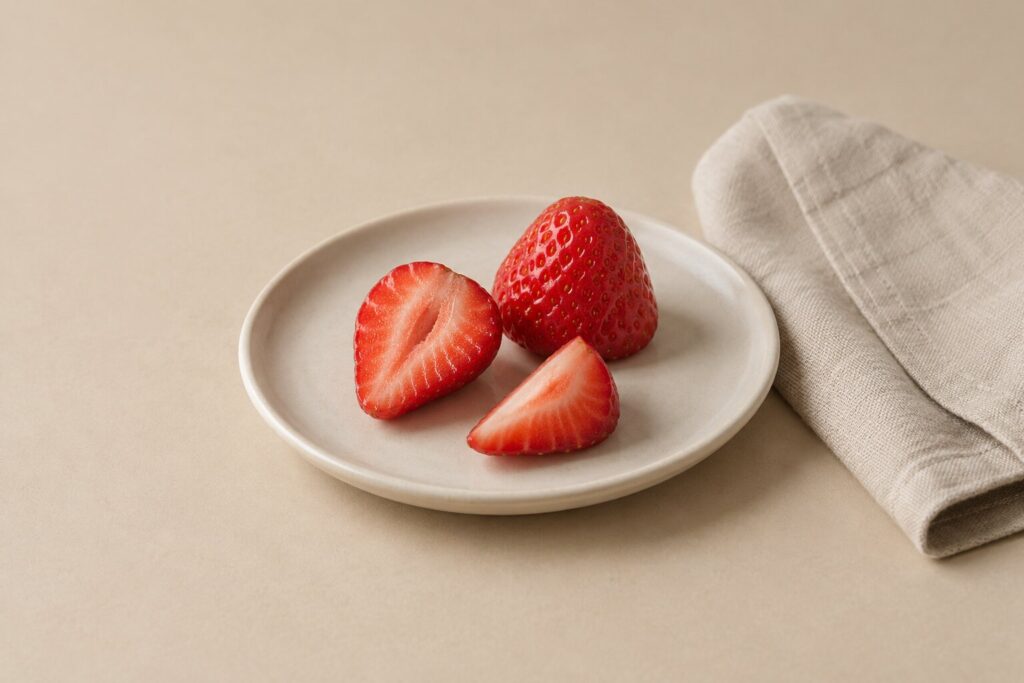
- Wash them. Strawberries hold surface residue more than most produce because of the skin texture.
- Take the stem and leaves off. Not toxic, just indigestible fiber that some dogs bring straight back up.
- Cut them down for small dogs. A whole strawberry is a plausible choking hazard for a terrier that swallows things whole. Halve or quarter it.
- Frozen works well. A frozen strawberry lasts longer and is useful in hot weather, though it is harder and needs cutting for small dogs.
- Puree is the gentlest introduction. Useful if you want to know whether your dog tolerates them before committing to whole berries.
The Preparations To Avoid
The berry is not the risk. What people do to it is.
- Anything labeled sugar free. Xylitol causes a rapid insulin release in dogs and can be fatal in small quantities. This is the single most dangerous thing in this article. Check the label on any prepared fruit product before it goes near your dog.
- Canned strawberries in syrup. Several times the sugar of a fresh berry, for no gain.
- Chocolate covered strawberries. Obvious once stated, easy to forget on a holiday table.
- Strawberry flavored anything. Yogurt, ice cream and jam are sugar and dairy delivery systems with a strawberry mentioned on the front.
What To Watch For Afterwards
Introduce one berry, then wait a day. If you see loose stools, vomiting, obvious itching or a jump in how much your dog is drinking, strawberries are not a good fit and there is no reason to persist. Fruit is optional.

Any of that continuing past a day, or arriving alongside lethargy or refusal to eat, is a vet call rather than a food question.
Other Berries
Blueberries, raspberries, blackberries and cranberries are all safe in the same small quantities, and blueberries are the pick of them: lower sugar than strawberries and small enough that portioning is easy. Cranberries are safe but bitter, and most dogs decline them.
The exceptions matter more than the list. Grapes and raisins are toxic to dogs and can cause kidney failure at doses that are not predictable from body weight, so there is no safe amount. Berries with pits, and juniper berries, are also off the table.
Where This Sits In The Actual Diet
Strawberries are a snack. They are not nutrition, and no amount of fruit compensates for a food that is not doing its job. If you want to know what your dog is actually living on, that is a label question, and the guaranteed analysis on the back of the bag is where the answer is. We convert every one we index to the same basis so two bags can be compared directly, which you can browse in the dog food reviews.
If you are curious how the fruit and vegetable ingredients in your dog’s food are actually being used, most of them appear in far smaller amounts than the bag art implies. The ingredient wiki covers what each one is and what it is doing there.
In The Kibble reads labels and publishes what the numbers say. Guides are general information, not veterinary advice. Your vet knows your dog's history and we do not, so take anything here to them before you change how you feed.
Found this useful?
Comments
No comments yet. Tried this with your dog? Tell other readers how it went.