
Ingredient file // Fiber
Psyllium Seed Husks
Useful stool fiber with modest dog evidence
Psyllium seed husks are the outer coats milled from psyllium seeds. Their fiber holds water and forms a gel that changes stool texture. Dog studies support a role in bowel care, but a husk listing alone cannot promise relief from diarrhea or constipation.
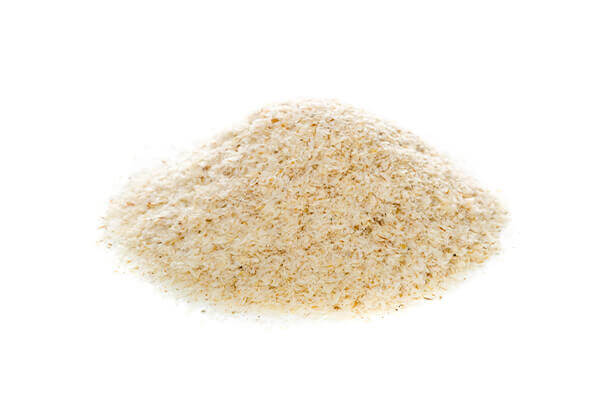
- What it is
- Dried outer seed coats, separated from psyllium seeds, with fiber that swells and gels when wet.
- Made from
- Outer coats of psyllium seeds
- Main job
- Water-holding fiber for stool
- Typical amount
- 0.2% in one disclosed kibble recipe
- Watch for
- Extra fiber needs adequate water
- Not the same as
- Whole psyllium seeds
Our read // In our catalog
In 1 of every 62 foods we track
Share of foods that list it
2%
42 of the 2,595 foods with an ingredient list on file, from 10 brands. 40 dry dog food, 1 wet dog food, 1 dog food topper.
Each square is 1% of the catalog
Where it sits on the label
Median position 16. In the top five of 0 foods, so it is usually a minor ingredient.
Above the salt
Listed before the salt in 50% of foods. In the rest it is under about 1% of the recipe.
Price per lb
Median of the cheapest bag price across 34 priced foods, 14% above the catalog. The price is the food's, not the ingredient's.
Who leans on it
55%
of the foods that list it are from Royal Canin. 10 brands use it in total.
What it is
How it is made
Psyllium is grown for its water-swelling seed coats. After harvest, mills dry and clean the seeds, loosen the coats and separate husks from the inner seed. Pet food makers buy the husks as a concentrated fiber.5,6,7
- 01 // Source Harvested seeds The outer coat is still attached when psyllium seeds leave the field.
- 02 // Process Dried and cleaned Drying lets mills clean and store the seeds before removing their coats.
- 03 // Process Coats separated Mechanical grinding loosens the husks, and air separation sorts them from the heavier inner seed.
- 04 // Output Psyllium husks Separated dry coats are graded and shipped as husks or ground into powder.
What is in it
Composition, dry matter
94.8
% total fiber
Total dietary fiber in one tested husk powder. The ingredient contributes fiber rather than meaningful protein or fat.
Why it is in the bag
What the manufacturer gets
-
01
Shapes loose stool
The husks take up water and form a gel. In a small study of dogs with chronic large bowel diarrhea, stools became more consistently formed during supplementation.1,4
-
02
Adds water to hard stool
Water held in fiber can soften feces and add bulk. The dog constipation trial tested ground whole seeds, so it does not isolate the husks used in food.2,9
-
03
Supplies concentrated specialty fiber
Psyllium is grown for its husk, which requires milling and separation. It is a commercial fiber crop; the published sources do not give its cost in a dog food recipe.4,5,6
How much One disclosed kibble fed to 6 dogs for 10 days held 0.2% husk; a separate supplement study gave 4 tablespoons daily.1,8
Our read // The claims
What the evidence supports
Strong: controlled studies in dogs agree. Some: small or mixed dog data. Thin: mechanism or lab work only. None: nothing, or the evidence points the other way.
-
Vets say
Psyllium firms chronic loose stools
Evidence
- Strong
- Some
- Thin
- None
In an uncontrolled study of 22 police dogs with chronic large bowel diarrhea, 90% passed consistently formed stools during husk supplementation. Without an untreated group, the study cannot measure how much of that change psyllium caused.1
-
Owners say
Psyllium fixes constipation in dogs
Outruns the evidence
Evidence
- Strong
- Some
- Thin
- None
An 8-dog feeding trial found wetter feces with ground whole psyllium seeds. Owners of constipated dogs also reported easier passage, but their dogs had no untreated comparison group. Neither study isolated the husks named on the bag.2
-
Brands say
Psyllium builds a healthier gut microbiome
Outruns the evidence
Evidence
- Strong
- Some
- Thin
- None
A randomized crossover trial in 17 healthy dogs found only minor changes in bacterial groups after husk supplementation, with questionable biological significance. It found no gut health benefit, so a healthier-microbiome promise goes beyond the result.3
-
Critics say
Psyllium is useless filler
Outruns the evidence
Evidence
- Strong
- Some
- Thin
- None
One tested husk powder was 94.8% dietary fiber on a dry matter basis, and a dog study measured a stool response during supplementation. It has a clear fiber job, even though that study cannot prove an effect in every food.1,4
Straight answers
What owners ask
-
Q01
Is it just filler?
NoIts water-holding fiber has a job: changing stool texture. Dogs in a small study passed firmer stools during supplementation. The ingredient name still cannot tell you whether the amount in this food will change your dog's stool.1,4
-
Q02
Are husks the same as seeds?
NoHusks are the separated outer coats. Whole psyllium seeds also contain the inner seed, so a constipation study using ground whole seeds cannot pin its results on husks alone.2,5
-
Q03
Should I add extra psyllium?
Not automaticallyA food label does not reveal its husk dose. Extra fiber needs adequate water and can worsen an impaction in a poorly hydrated, constipated dog. Persistent straining needs assessment before more fiber is added.9
Who uses it
Brands, best sellers and the company it keeps
Top brands, by foods that list it
Usually listed with, share of the foods that list it
- Chicken Fat 81%
- Natural Flavor 67%
- Dried Plain Beet Pulp 57%
- Wheat Gluten 55%
- Chicken By-Product Meal 52%
- Corn Gluten Meal 48%
- Brewers Rice 48%
- Corn 40%
- Brown Rice 40%
- Fish Oil 29%
- Wheat 24%
- Egg Product 21%
Our read // On the bag
Read it as a targeted fiber ingredient
Psyllium seed husks low on a bag's list signal a fiber adjustment, not a promise to treat bowel disease. Check the food's total fiber and your dog's stool. If diarrhea or constipation persists, the ingredient name cannot tell you the dose or the cause.
On labels as
Other names for this
Manufacturers do not all use the same wording. These all mean the same thing.
Sources
What we read
Checked September 1, 2026.
- 1 The use of soluble fibre for the management of chronic idiopathic large-bowel diarrhoea in police working dogs
- 2 The use of psyllium to control constipation in dogs
- 3 Microbiota of healthy dogs demonstrate a significant decrease in richness and changes in specific bacterial groups in response to supplementation with resistant starch, but not psyllium or methylcellulose, in a randomized cross-over trial
- 4 In vivo effect of two different dietary fiber blends on the milk calcium bioavailability
- 5 Design Development and Performance Evaluation of Psyllium (Ispaghol) Husk Separator Cum Grader
- 6 Morphological and developmental analysis of Plantago spp. seed capsules reveals key features of the dehiscence zones
- 7 Psyllium
- 8 Psyllium pet food composition
- 9 Constipation, Obstipation, and Megacolon in Small Animals
- 10 Paws Off! Xylitol is Toxic to Dogs