Can Dogs Eat Eggs?
Cooked eggs are one of the best treats you can give a dog. The only real decisions are how you cook them, how many, and whether raw is worth it. It is not.

Yes. Cooked eggs are one of the best treats you can give a dog. Egg protein is the standard other proteins get measured against, dogs digest it almost completely, and a whole egg brings selenium, riboflavin, B12 and choline along with it.
The only real decisions are how you cook it, how many, and whether raw is worth the trouble. It is not.
How Many Eggs
A large egg is about 70 calories, which is more than people expect from something that small. Against the usual rule that treats and extras stay under 10% of daily calories, that works out roughly as:
| Dog weight | Rough daily calories | 10% budget | Egg equivalent |
|---|---|---|---|
| 10 lb | ~350 | ~35 cal | Half an egg |
| 30 lb | ~750 | ~75 cal | One egg |
| 60 lb | ~1,250 | ~125 cal | One to two eggs |
That is a ceiling for a day on which the egg is the only extra, not a daily target. A few times a week is a sensible rhythm for most dogs.
Can Dogs Eat Raw Eggs?
They can, and there is no good reason to. Two arguments are usually made for raw eggs and both are weaker than they sound.
Salmonella. Dogs handle bacterial loads better than people do, so most dogs eating a raw egg will be fine. The problem is the same as with raw chicken: a dog can shed salmonella without being ill itself, which puts the rest of the household at risk. That matters more in a house with small children or anyone immunocompromised.
Biotin. Raw egg white contains avidin, which binds biotin and blocks its absorption. This gets repeated as if a single raw egg causes a deficiency, which is not true: you would need to feed a lot of raw white, regularly, over a long period. It is a real mechanism and a small practical risk. Worth knowing, not worth panicking about.
Cooking solves both at once. It kills the bacteria and denatures the avidin, and it costs you nothing nutritionally. There is no version of this where raw comes out ahead.
Boiled And Hard Boiled Eggs
The best method, and the simplest. Nothing is added, nothing is cooked off, and a hard boiled egg is easy to portion and easy to carry as a training treat.
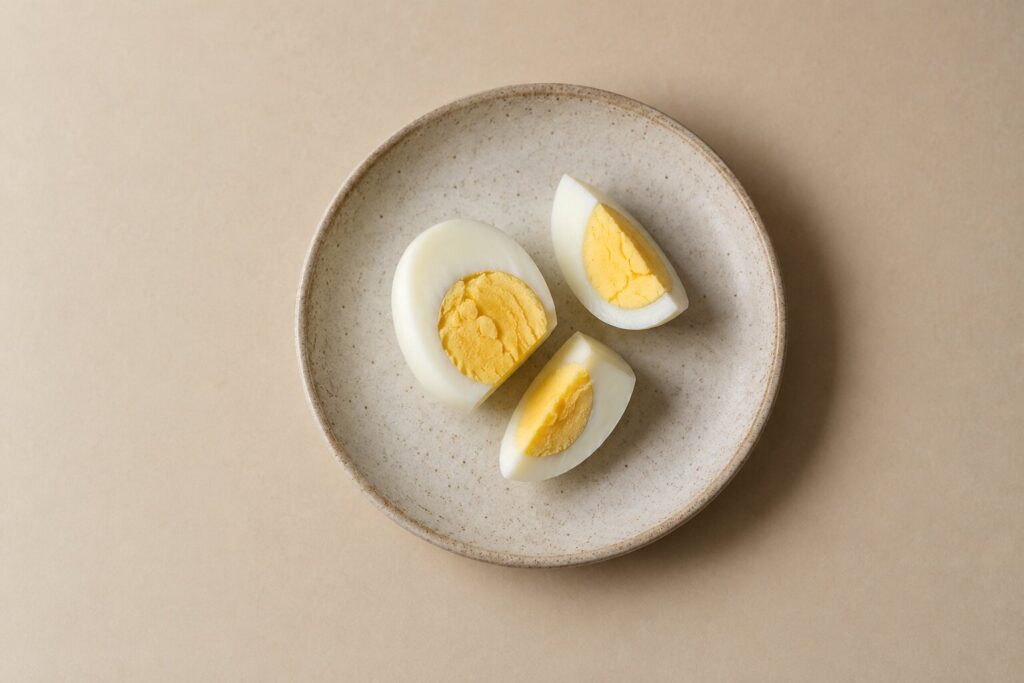
Boil it, cool it, peel it, and chop it into pieces your dog cannot swallow whole. No salt in the water and no butter afterwards.
Scrambled Eggs
Fine, with a condition attached that most people ignore: scramble them dry. No butter, no oil, no milk or cream, and no salt.
Butter and cream are fat, which is calories your dog does not need and a pancreatitis risk in dogs prone to it. Milk is a second problem, because most adult dogs lose the ability to digest lactose and it produces loose stools. A non stick pan and a low heat will scramble an egg perfectly well with nothing in it.
Scrambled is genuinely useful for a dog that is off its food or has just come through a stomach upset, because it is soft, warm and aromatic. It is also easy to over-serve for exactly that reason.
Fried Eggs
Skip them. The egg is fine; the oil or butter it was cooked in is the issue, and a fried egg carries considerably more fat than a boiled one for no benefit.
What About The Shell?
Eggshell is calcium carbonate and is sometimes ground up as a calcium supplement. Two cautions. Whole or broken shell fragments are sharp enough to be a hazard and should not be fed. And a dog on a complete commercial food is already getting the calcium it needs, so adding more is not neutral: excess calcium interferes with mineral balance and is a genuine problem in large breed puppies, where it contributes to skeletal disease.
If your vet has told you to supplement calcium, follow their instruction. Otherwise there is no gap here to fill.
Are Duck And Quail Eggs Different?
Nutritionally similar, somewhat richer and larger, and they follow all the same rules: cooked, plain, portioned by calories rather than by count. A duck egg is roughly half again the size of a chicken egg, so adjust accordingly.
When To Skip Eggs

- Dogs with a confirmed egg allergy. Uncommon but real, and it usually shows as itching, ear trouble and paw chewing rather than digestive signs.
- Dogs on an elimination diet. Nothing but the trial food goes in, or the trial is worthless.
- Dogs with pancreatitis history, if the egg is coming with butter or oil. Plain boiled is usually fine, but check with your vet.
- Overweight dogs. Eggs are not diet food at 70 calories each. Green beans do the volume job for a fraction of that.
Eggs In Commercial Dog Food
Seeing egg on an ingredient panel is a good sign rather than a marketing flourish, because it is expensive and manufacturers do not add it for decoration. It is usually present in small amounts for that reason.
You will also see “dried egg product” or “egg product”, which is egg that has been processed and dried. It is a legitimate ingredient and more concentrated than fresh egg, since the panel weighs ingredients before cooking and fresh egg is mostly water.
Egg is worth understanding as a benchmark more than as an additive. Its amino acid profile is the reference other proteins are scored against, which is why it comes up constantly in discussions of protein quality. There is more on how that works in our guide to the best protein sources in dog food, and you can compare what is actually in the bags we index in the dog food reviews.
How To Serve Them
- Cook them through. Boiled is best, dry scrambled is fine.
- Nothing added: no salt, butter, oil, milk or seasoning.
- Chop into pieces sized to your dog.
- No shell.
- Start with a small portion and give it a day before deciding it agrees with them.
- Count the calories against the meal rather than on top of it.
In The Kibble reads labels and publishes what the numbers say. Guides are general information, not veterinary advice. Your vet knows your dog's history and we do not, so take anything here to them before you change how you feed.
Found this useful?
Comments
No comments yet. Tried this with your dog? Tell other readers how it went.